“The Direction of Indonesian Diplomacy”
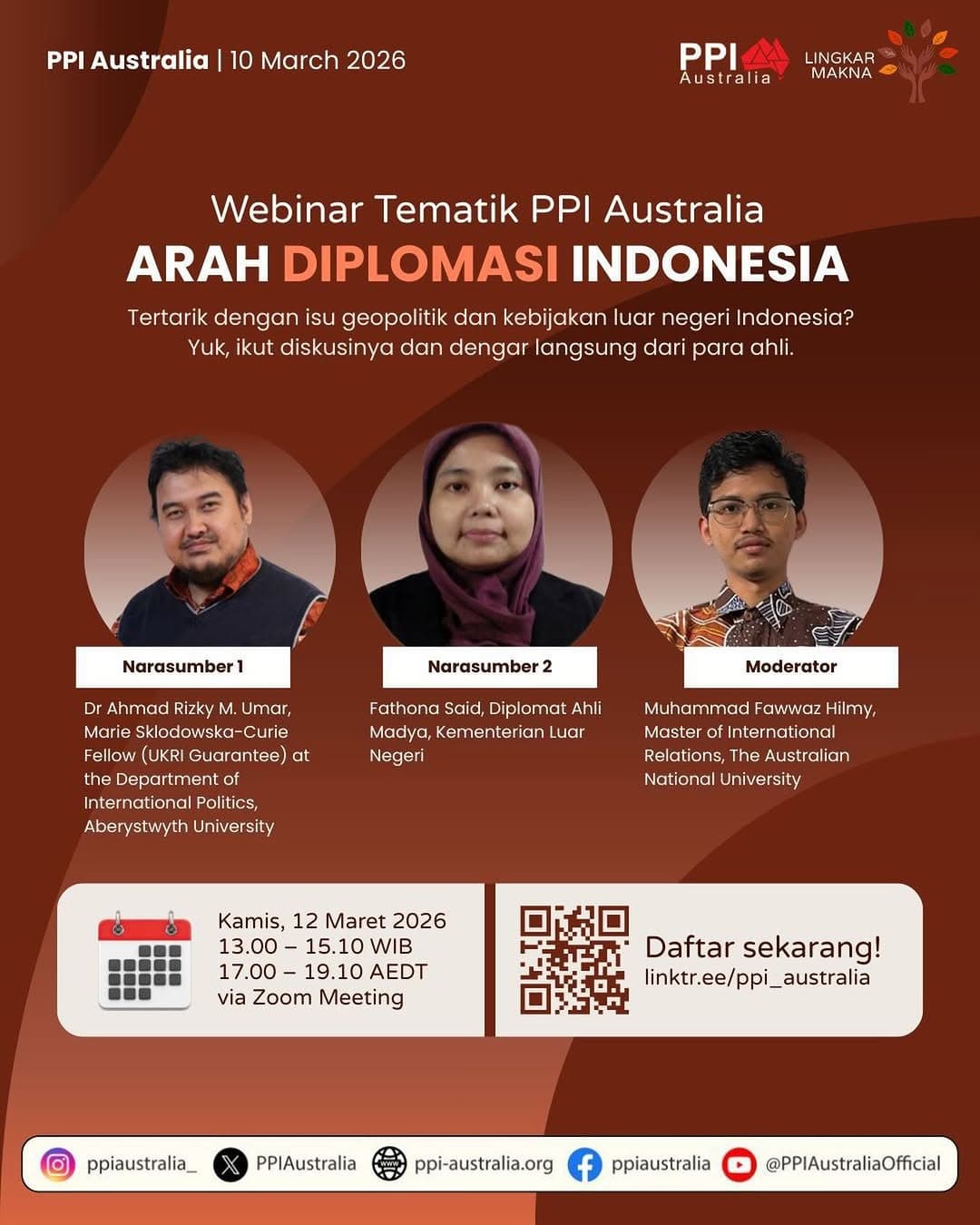
The Direction of Indonesian Diplomacy
Written by IT (5/10/2026)
Artikel Written By: Sultan Rifat A (Directorate of Public and Alumni Relations)
Canberra, 14 February 2026 – The Indonesian Students Association in Australia (PPIA) for the 2025/2026 period held a webinar titled “The Direction of Indonesian Diplomacy” on Saturday, 14 February 2026. The discussion featured two speakers with different perspectives: Fathona Said, Intermediate Expert Diplomat at the Ministry of Foreign Affairs of the Republic of Indonesia from the Middle East Directorate, and Dr. Ahmad Rizky M. Umar, Marie Sklodowska-Curie Fellow from Aberystwyth University. The event was moderated by Muhammad Fawwaz Hilmy and attended by participants from various countries.
The President of PPIA 2025/2026, Muhammad Hadiyan Ridho, in his opening remarks emphasized that the issue of Indonesian diplomacy has become increasingly relevant amid increasingly complex global geopolitical dynamics. He stated that the presence of audiences from various countries demonstrated that diplomacy is not only an Indonesian concern, but also part of broader global anxieties. Through this forum, Indonesian students were expected to gain a more comprehensive understanding of the direction of Indonesia’s foreign policy and develop a critical perspective toward government policies.
In his presentation, Fathona Said explained that the Middle East region is currently facing increasing security dynamics. Several Gulf countries are known to have condemned Iran while strengthening airspace security systems, defense, and energy resilience. Regional coordination is also continuously carried out through the Gulf Cooperation Council (GCC).
Amid rising tensions, Oman is considered to be taking a relatively balanced position by emphasizing the importance of dialogue and maintaining communication channels between the United States and Iran. Diplomatic efforts are also continuing within the United Nations Security Council (UNSC), although they face political challenges, particularly because the United States is serving as President of the Security Council until March 2026, as well as Bahrain’s position as a non-permanent member until 2027.
Fathona also highlighted that geopolitical conditions in the region have a direct impact on Indonesian interests. This is due to the large number of Indonesian citizens living in the Middle East. It is recorded that approximately 495,800 Indonesian citizens reside across ten countries in the region, with the largest concentrations in Saudi Arabia (around 361,000 people), the United Arab Emirates (around 81,000 people), and Qatar (around 27,000 people).
In response to the situation, the Indonesian government has implemented various measures, including intensive monitoring through Indonesian Embassies and Consulates General, activating hotline services, and maintaining communication with Indonesian communities in the region. The government also continues coordinating with local authorities and handling citizens affected by flight cancellations.
Furthermore, Fathona emphasized that Indonesian diplomacy continues to adhere to the free and active foreign policy principle by encouraging conflict resolution through dialogue and diplomacy. In an official government statement on 28 February 2026, Indonesia expressed regret over the failure of nuclear negotiations between the United States and Iran and called on all parties to exercise restraint and respect state sovereignty.
Indonesia also expressed readiness to support various dialogue efforts, including the possibility of facilitating mediation if agreed upon by the involved parties. However, the diplomatic space is currently considered very limited.
At the multilateral level, Indonesia continues encouraging the United Nations Security Council to take a role in de-escalating the conflict and continuing nuclear negotiations. Meanwhile, in bilateral diplomacy, the Indonesian government has coordinated with several regional countries such as Saudi Arabia, the United Arab Emirates, Qatar, and Jordan.
Meanwhile, Dr. Ahmad Rizky M. Umar provided an academic analysis regarding changes in the structure of international politics. According to him, the current liberal international order is experiencing a crisis of legitimacy, marked by weakening international institutions and increasing great power competition.
He also highlighted the phenomenon of the “weaponization of interdependence,” a condition where global economic relations are utilized as instruments in geopolitical competition. Security turbulence occurring in West Asia, Eastern Europe, and Latin America also carries strategic implications for the Indo-Pacific region.
In the context of conflict in West Asia, Umar explained that the ongoing war is a continuation of the series of conflicts originating from the Gaza War. The conflict later developed into a broader confrontation involving Iran, Israel, and the United States.
He also mentioned the event known as the “Ramadan War 2026,” marked by joint military operations by the United States and Israel against Iran, as well as Iran’s retaliatory attacks on United States military facilities. The conflict affected the closure of the Strait of Hormuz, disruptions to international flights, rising global energy prices, and economic pressure in various countries.
Umar explained that under President Prabowo’s administration, the direction of Indonesian foreign policy shows a tendency toward a multi-alignment approach, namely establishing relations simultaneously with various global powers. Indonesia is also involved in various international forums such as BRICS, Board of Peace (BoP), and several international stabilization initiatives.
However, he assessed that Indonesia faces several strategic dilemmas, particularly regarding involvement in conflicts in West Asia, which require significant diplomatic and political costs. According to him, Indonesia needs to reconsider its foreign policy priorities, including the possibility of focusing diplomacy more on the ASEAN and East Asian regions.
During the discussion session, both speakers agreed that Indonesia needs to be cautious to avoid experiencing “diplomatic fatigue” due to involvement in too many international forums. Umar argued that Indonesia’s geographical and strategic capacity is more relevant for playing a role in Southeast Asia and East Asia.
In addition, the discussion also addressed controversies surrounding the Board of Peace (BoP), which was considered to have weak legitimacy because it was not formed through strong multilateral consensus. Both speakers emphasized the importance of Indonesia continuing to uphold the mandate of international law, particularly within the framework of the United Nations.
Responding to questions regarding the potential escalation of conflicts into a world war, Umar explained that a nuclear war scenario is currently not considered the main possibility because major countries still adhere to the “no first use” doctrine and because various unofficial negotiation channels continue to operate. Nevertheless, the potential for proxy conflicts and regional escalation still needs to be anticipated.
This webinar provided broader insight into the direction of Indonesian diplomacy amid increasingly complex global geopolitical dynamics. The discussion between diplomatic practitioners and academics demonstrated the importance of combining practical policy perspectives with critical analysis in understanding Indonesia’s strategic position on the international stage.