Exploring Study Opportunities in Australia: Discovering Pathways Across Universities
Exploring Study Opportunities in Australia
Written by IT (5/10/2026)
Artikel Written By: Sultan Rifat A (Directorate of Public and Alumni Relations)
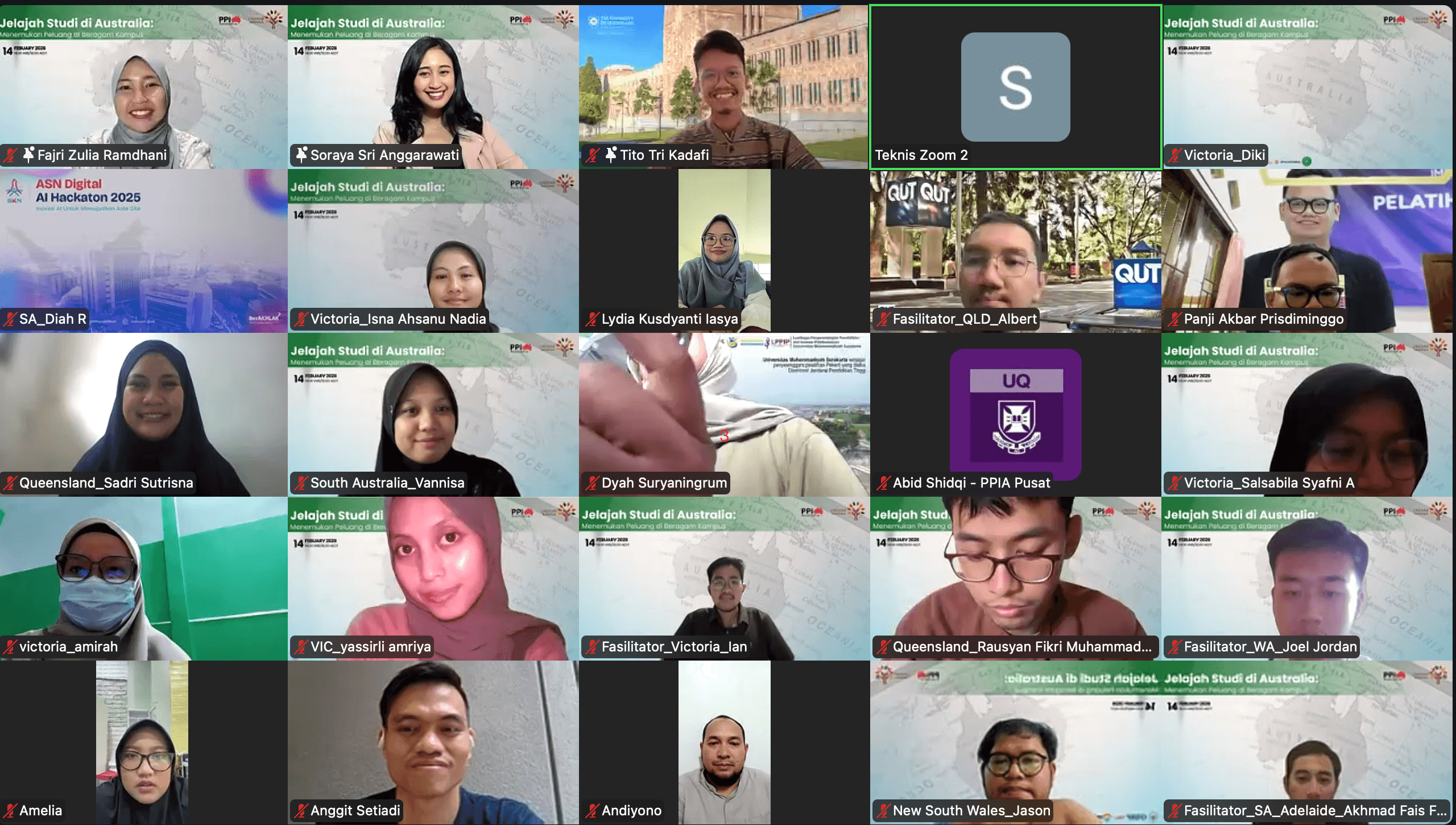
PPI Australia continues to initiate a more inclusive Australian higher education campaign through a webinar titled “Exploring Study in Australia: Discovering Opportunities Across Universities”, which was successfully held on Saturday, 14 February 2026 via the Zoom Meeting platform. The event aims to help participants gain an overview of study opportunities in Australia, while also assisting attendees in preparing themselves for various study opportunities in Australia that will be available in 2026.
This event was supported by the Indonesian Embassy in Canberra and 7 PPIA branches across Australia, while also featuring Prof. Yuli Rahmawati, M.Sc., Ph.D as the Education and Culture Attaché of the Republic of Indonesia for Australia and Vanuatu, Tito Tri Kadafi as a Master’s student at the University of Queensland, and Fajri Zulia Ramdhani as a PhD student at Western Sydney University as speakers who delivered their respective materials in a very informative and interactive manner.
During the opening session, Muhammad Hadiyan Ridho as President of PPIA 2025/2026 stated that in 2025, there were 30,000 Indonesian students studying in Australia, although 20,000 of them were concentrated in New South Wales (NSW) and Victoria (VIC).
“However, this does not prevent other scholarship hunters from getting the opportunity to study in Australia outside those regions,” he said.
In addition, Ridho also stated that after this webinar, there will be a follow-up webinar specifically discussing scholarships in Australia.
During the forum, Prof. Yuli Rahmawati, M.Sc., Ph.D also explained her role as Education and Culture Attaché at the Indonesian Embassy, and also explained the history of PPIA itself. She also provided a comparison of education conditions in Indonesia and Australia, where the most striking difference is the number of schools and universities in Indonesia, which is significantly higher compared to those in Australia.
She also explained that Australia builds its education ecosystem on three main pillars. First are universities, which focus on in-depth research, innovation, and knowledge development through undergraduate to doctoral programs. Second is the TAFE (Technical and Further Education) and VET (Vocational Education and Training) sector, which emphasizes job-ready practical skills. Third are Private Colleges, which are institutions offering professional courses and diploma programs.
One of the most crucial points raised is regarding the duration of undergraduate studies in Australia, which generally takes 3 to 4 years.
“For those pursuing a 3-year undergraduate degree in Australia, the relevant Indonesian ministry is currently working to ensure that it can be recognized as a bachelor’s degree, not a diploma,” she said.
This step is expected to simplify bureaucracy for overseas graduates in pursuing careers in both government and private sectors in Indonesia.
In addition to regular programs, she also stated that Australia offers flexibility through Double Degree and Joint Degree programs. Institutional dynamics are also continuously evolving, marked by recent information on mergers of several major universities and the increasing presence of branch campuses.
She concluded her presentation by explaining that studying in Australia is not only about earning a degree, but also an investment in experience. A multicultural environment and practical learning methods provide students with a competitive advantage. Abundant scholarship opportunities and post-study work visa policies are key attractions, although adaptation challenges and global competition remain important factors to prepare for.
Moving to the second speaker, Tito Tri Kadafi introduced himself as an awardee of the Australia Awards Scholarship (AAS). He explained the details of the AAS scholarship, which aims to identify future leaders who are expected to drive change in Indonesia. He also emphasized that AAS is highly inclusive, providing equal opportunities for individuals from all backgrounds who wish to apply.
Tito shared that through this scholarship, he has gained many opportunities in his personal development journey.
“In this semester, I have been to 5 states in Australia and 6 countries. The university and scholarship allow this because both support development through new opportunities I gained when I entered UQ,” he said.
At the end of his presentation, Tito suggested that all participants access the CRICOS website to explore study programs from Australian universities, allowing them to broaden their university choices.
Moving to the third speaker, Fajri Zulia Ramdhani is an awardee of the Indonesia Endowment Fund for Education and the Ministry of Religious Affairs scholarship. This indirectly shows that scholarship opportunities in Indonesia are very diverse and encourages participants not to focus on only one scholarship.
In her presentation, she explained her reasons for pursuing a PhD in Australia as well as her experience living in Australia during her studies.
However, the most crucial part of Zulia’s session was her tips on obtaining a supervisor. She explained in detail to the participants, starting from how to find supervisors at her university, how to send emails to prospective supervisors, what to avoid when contacting them, and what should be done after getting a supervisor.
As a PhD student, Zulia also shared her journey when she first started her studies, including orientation, mandatory training, developing a research plan, and regularly reporting her research progress. Before concluding her presentation, she also explained her perspective that a PhD is not always “lonely,” as there are many Indonesian students in Australia pursuing doctoral studies.
“There are many campus programs so PhD students do not feel alone. Don’t forget to join associations related to your field, join communities to have activities outside research, and do not hesitate to visit campus wellbeing services for stress relief,” she said.
The webinar did not stop at presentations only; it also provided opportunities for participants to ask questions to all speakers and engage in two-way discussions with facilitators in breakout rooms between participants and facilitators who are members of PPI from each branch.
The outcome of the event was immediately reflected in one participant’s feedback:
“Now I have a clearer picture of study options in Australia, and I would really like to have a group to discuss further with facilitators so I can feel more confident in choosing a university for study in Australia,” said one participant who attended the event.